
San Antonio Modern Folk Art
Karl James Lubbering — KLube
Born July 11, 1969 • San Antonio, Texas
An Artist of San Antonio
Karl James Lubbering, known professionally as KLube, is a San Antonio-born visual artist and musician whose work draws upon an unusually rich mixture of family history, Texas culture, music, folk imagery, modernism and lived experience. Working frequently on a large scale and with exuberant color, geometry and expressive figures, Lubbering has developed a visual language he calls “San Antonio Modern Folk Art.”
The phrase is particularly appropriate because Lubbering’s relationship with San Antonio extends far beyond birthplace. His paintings emerge from a family rooted in Texas for generations and from a childhood immersed in both art and the distinctive cultural landscape of South and Central Texas.
His work can be whimsical, humorous and immediately accessible: cats, birds, cowboys, musicians, faces and fantastic figures populate his canvases. Yet beneath their apparent spontaneity is a sophisticated awareness of composition. Geometric shapes divide and reorganize pictorial space. Colors answer one another rhythmically. Figures can appear simultaneously primitive, modern and monumental.
Lubbering’s paintings resist easy classification because their sources resist it as well. Texas folk culture, contemporary art, music, childhood memory, modern design and the visual intensity of San Antonio all coexist within them.
That synthesis began with his family.
Two Texas Inheritances
Karl was born in San Antonio on July 11, 1969, to Louis P. Lubbering Jr. and Marilyn Lubbering. Both parents profoundly influenced their son’s development, although they gave him different kinds of inheritance.
His father, Louis P. Lubbering Jr. (1944–2020), was a professional artist and longtime art educator who earned four degrees in art and taught generations of Texas students. Karl grew up attending some of his father’s classes and observing firsthand the discipline required to sustain a life devoted to art.
Karl’s artistic lineage extended beyond his father. His great-uncle Guy Linton was another San Antonio artist and an unconventional figure in the city’s cultural history. In 1970, Linton transformed his Green Gate nightclub on St. Mary’s Street into an art gallery. For Karl, both men offered examples of artists who persisted in making work whether or not the circumstances surrounding them were easy.
Karl’s signature, KLube, carries his father’s memory directly onto his paintings. Louis was affectionately known as “Mr. Lube,” and Karl’s abbreviated artistic name became, in part, an homage to him.
Yet focusing exclusively upon the Lubbering artistic lineage misses half of Karl’s Texas story.
His mother, Marilyn, gave her children another inheritance—one grounded in generations of South Central Texas family life, agricultural work and attachment to the land.
As a child, Karl visited the farm of his maternal great-grandparents, Louis and Lydia Jahns Giesick, near Seguin, Texas. For a young boy, the farm was a magical environment: a world of land, animals, family, work and freedom markedly different from his everyday life in San Antonio.
Louis and Lydia were hardworking people, and the farm exposed Karl to an older Texas whose rhythms were still tied closely to the land. Those childhood experiences became part of the storehouse of memories from which an artist eventually draws.
It would be too simple to assign a particular cowboy, bird, animal or landscape in Karl’s mature paintings directly to his childhood visits to Seguin. Art rarely develops so literally. But the farm forms an important part of the visual and emotional environment in which Karl’s understanding of Texas was created.
The roots of that maternal Texas inheritance reach into the nineteenth century.
Marilyn’s ancestor Conrad Ewald emigrated from Zennern in Kurhessen, accompanied by his wife Elisa, née Riemenschneider. Their immigration is recorded on page 91 of Chester William and Ethel Hander Geue’s A New Land Beckoned: German Immigration to Texas, 1844–1847. The record associates the couple with Fredericksburg and documents their passage to Texas aboard the Johann Dethardt in 1845.
Thus, generations before Karl was born, one branch of his mother’s family had already participated in the great German migration that helped shape Central Texas.
That history matters to an understanding of Karl because his identity as a Texan is neither a marketing device nor an artistic persona adopted later in life. It is inherited experience.
Through Louis, Karl inherited the studio, the classroom, art history and the example of a working artist.
Through Marilyn and the Giesick and Ewald families, he inherited another Texas: farms and small communities, German-Texan history, hard work, land and multigenerational belonging.
The two inheritances meet in KLube.
San Antonio College, Topaz and The Cove
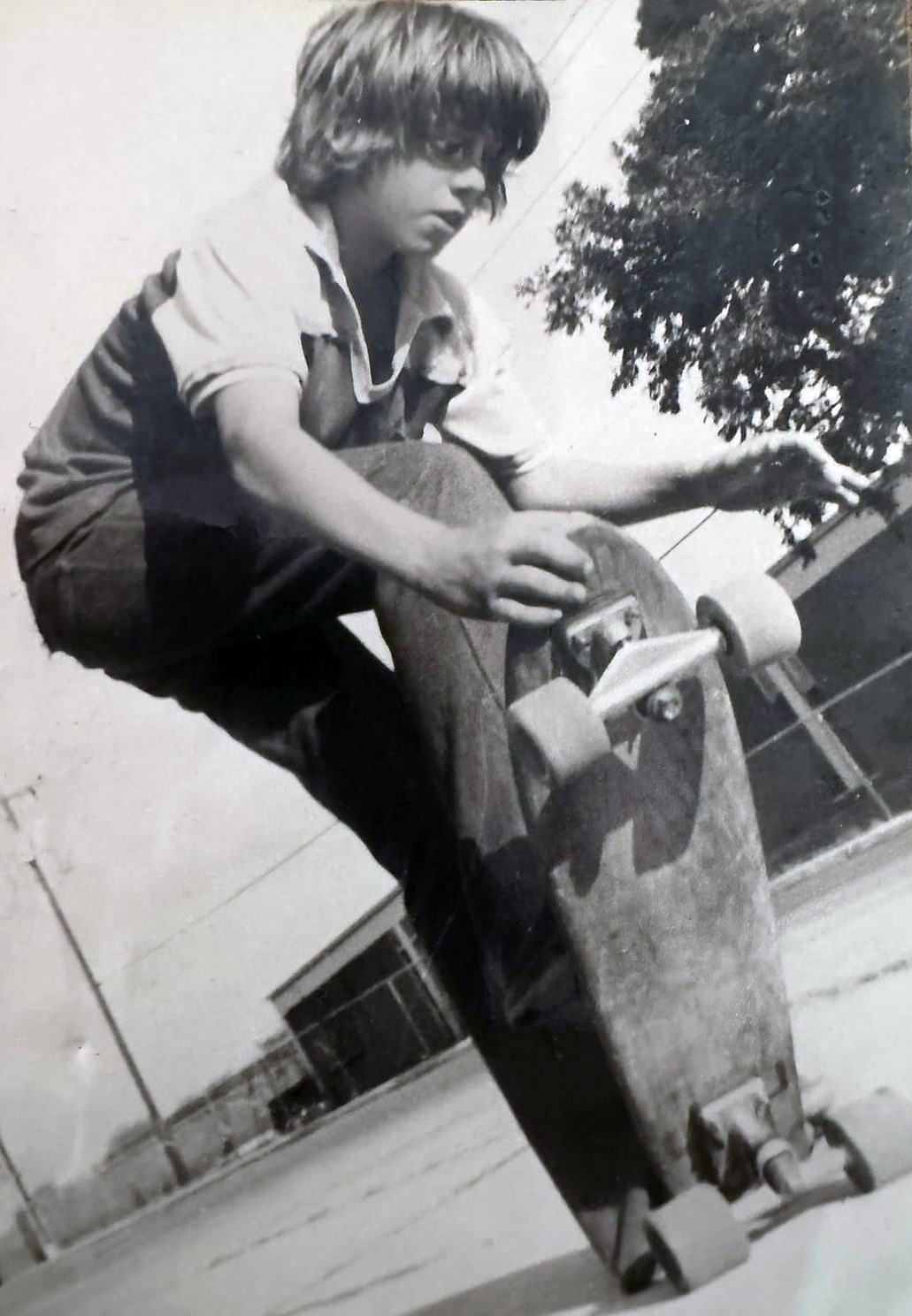
In his early adult years, Karl’s life was already divided between visual art and music. He attended San Antonio College, where he took art classes and continued developing as a painter while pursuing music seriously. His original songs were played on KSYM 90.1 FM, the college radio station, giving him an early local audience for music of his own.
At the same time, Karl played regularly with the band Topaz, performing almost every weekend in bars and venues across South and Central Texas. The group played primarily cover songs, and for Karl the work was practical as well as artistic: it provided dependable weekly income while allowing him to build considerable experience as a live musician. One memorable milestone came when Topaz opened for Selena at a Tejano music event, placing Karl briefly on a bill with one of the defining Texas performers of her generation.
San Antonio College also led to relationships that would remain important throughout Karl’s life. There he developed a lifelong friendship with Lisa and Sam Asvestes, later proprietors of The Cove, one of San Antonio’s most distinctive gathering places: a restaurant, car wash, laundromat and playground that also became a welcoming home for local music and art.
The Asvestes family created an environment in which musicians could perform, artists could show work, families could gather and different parts of San Antonio’s creative community could overlap naturally. The Cove became especially important to Karl. It was there that he further developed his ability to perform his original music live while continuing the more commercial repertoire that had sustained him through Topaz.
Karl also hung and sold his paintings at The Cove, making the venue one of the earliest places where his visual art and music existed side by side in public.
Over time, his relationship with Lisa and Sam deepened into a lasting friendship. Lisa eventually asked Karl to create a logo for The Cove, an image that continues to appear on its T-shirts and signage. The commission became a small but enduring example of Karl’s visual language becoming woven into the identity of a San Antonio institution closely associated with his own development.
The Asvestes family’s generosity extended to the Lubbering family more broadly. In 2010, Lisa and Sam presented a small retrospective of Louis P. Lubbering Jr.’s work in the Green House next to The Cove, recognizing the artistic legacy from which Karl himself had emerged.
That friendship has continued over the decades. Karl still performs regularly at Sanchos Cantina & Cocina, Sam Asvestes’s music, bar and food venue near The Cove. There, the KLube Trio & Friends continues Karl’s long tradition of live performance, with Sal Guajardo and Ray Palmer as his regular musical companions.
This period helps explain why Karl’s later career cannot be divided neatly into “music” and “painting.” The two practices grew together. SAC gave him formal art study and a platform for original music; Topaz gave him steady professional performance experience; The Cove gave him a community in which music, painting, friendship and local culture could all coexist.
Music, Taco Land and the Alternative City
Karl’s visual development remained inseparable from San Antonio’s music culture.
He became part of the alternative scene surrounding venues such as the legendary Taco Land, where he played guitar with Three Guys Walking. For years, the band played Sunday nights at Taco Land and opened for larger acts during the week. The experience placed Karl within a famously unconventional community in which musicians, artists, outsiders and creative personalities mixed freely.
That world eventually returned to his visual-art career.
In 2022, Karl joined Fred Himes, Michael Wally Olivarri and Eric J. Lozano for an exhibition at JojoDancer Photography Studio in the Blue Star Arts Complex. The exhibition reunited figures connected to San Antonio’s music and visual-art communities, and Karl also performed during the accompanying weekend.
Music appears directly in many of Karl’s paintings through guitars, musicians and club imagery, but its influence is also structural. Repeated shapes operate almost as beats. Colors respond to one another. Figures and symbols move across large canvases with an improvisational energy.
By the early 2020s Karl increasingly concentrated his creative energy on visual art. He also discovered that scale could radically change his relationship with a painting. Standing before a large canvas offered the possibility of entering the work physically and psychologically rather than simply regarding it from a distance.
The circumstances under which those large paintings developed were deeply personal.
Robert Barrett and Antiques on Hildebrand
After the death of his father in 2020, Karl entered an important transitional period. He was grieving Louis while also helping care for his mother, Marilyn, who had lived for many years with metastatic cancer.
During this period, Antiques on Hildebrand became an unexpected artistic sanctuary.
There, Robert Barrett and his family gave Karl space in which to work. Barrett became both mentor and critic, encouraging Karl as he began painting increasingly large canvases. Karl has described Barrett as his favorite art critic.
That relationship helped Karl regain confidence while giving him an environment in which experimentation could take place outside the immediate pressures of a conventional gallery.
At Antiques on Hildebrand, the scale of KLube’s paintings expanded. Forms that had previously functioned as shapes could become architectural elements. Areas of color became environments rather than accents. Figures could inhabit a canvas physically rather than merely appear upon it.
The distinction is important: the large paintings did not originate because a gallery asked Karl to produce them.
They emerged first through work, experimentation, grief, mentorship and the opportunity Robert Barrett gave him to occupy space as an artist.
The galleries came afterward.
Period Modern: A New Sphere for the Large Paintings
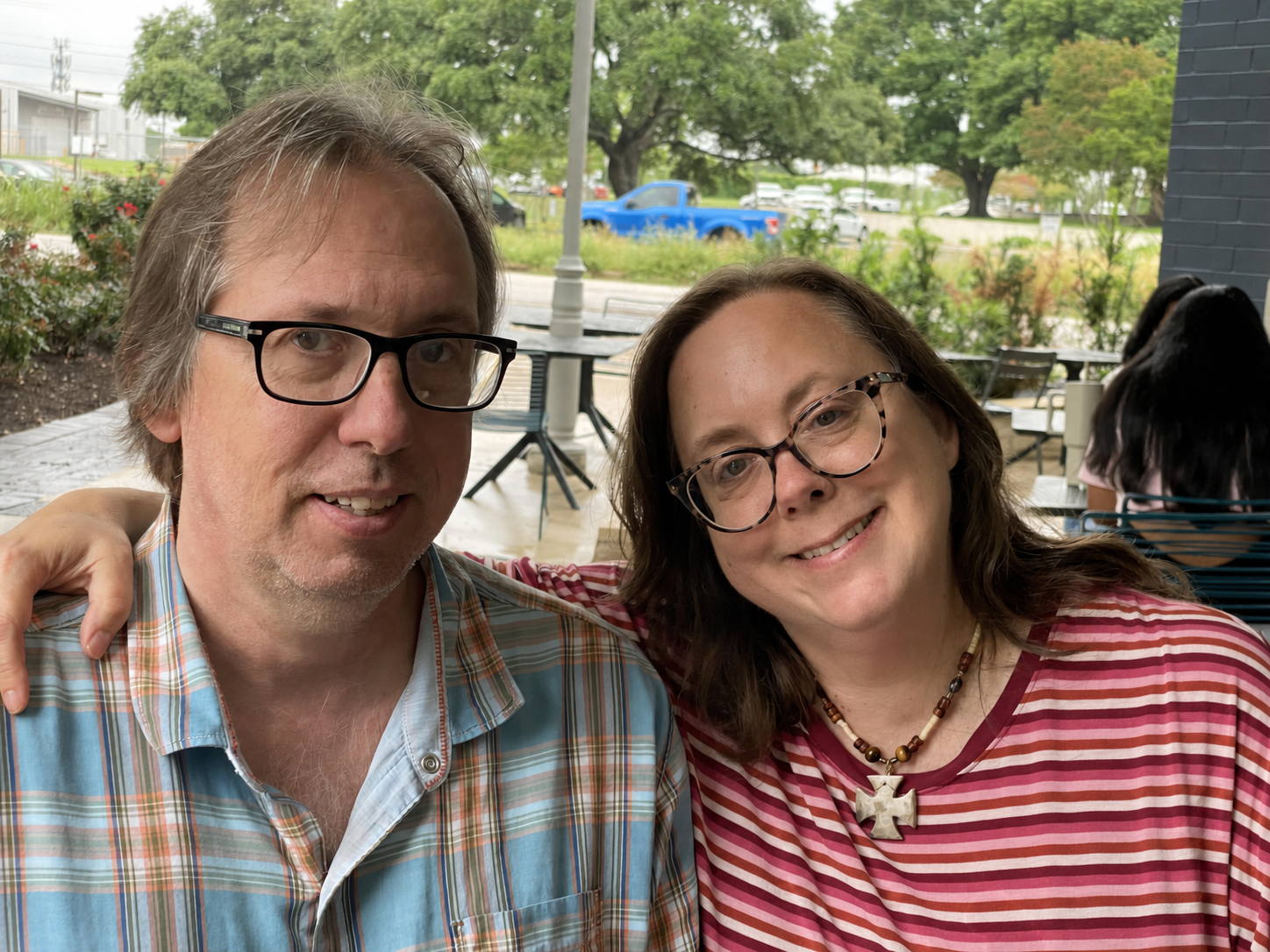
Following his formative period with Barrett, Karl established what became one of the most important professional relationships of his mature career: his partnership with Period Modern in the Olmos Park area of San Antonio.
The timing was significant. Karl had developed the confidence to work on a much larger scale, but large paintings require more than a studio in which to create them. They also require an environment capable of showing viewers how they can inhabit space.
Period Modern provided precisely that setting.
Surrounded by carefully selected modern and mid-century furniture, lighting and design, KLube’s increasingly monumental paintings could be experienced not simply as objects hanging on a wall but as powerful elements within a complete visual environment. Their saturated colors, geometric structures and folk-inspired figures proved particularly compatible with twentieth-century modern design.
Karl specifically credits Ted and Donna at Period Modern with giving him direction and providing a place where his art could continue to develop as it evolved. Their contribution, however, extended beyond Karl alone.
Ted and Donna embraced Karl and other local artists, bringing their work into a sophisticated design environment and introducing it to a new sphere of collectors. In doing so, they helped elevate both the presentation and perception of their work.
For Karl, this was an important step. Paintings that had grown physically and creatively under Barrett’s encouragement were now being presented to collectors at the scale and in the surroundings they demanded. Period Modern helped create a bridge between Karl’s experimental development as a large-scale painter and the expanding professional market for KLube.
The relationship became an ongoing one. In July 2024, Period Modern presented Shape Theory, bringing Karl together with Norman Avila, Rome Azzaro, Cel Calleros, Hilary Jean and Devin Ruiz.
In May 2025 came another significant Period Modern exhibition, Abstracts Only! The show foregrounded an aspect of KLube’s work that can sometimes be obscured by the memorable cats, cowboys, musicians and figures populating his canvases: Karl is also fundamentally an abstract painter.
Geometry organizes much of his visual language. Color frequently operates independently of natural appearance, and large areas of his canvases function as fields of shape, rhythm and movement. Abstracts Only! allowed this side of his practice to move to the foreground while once again bringing Karl’s visual art and music into the same creative environment.
Period Modern therefore occupies a crucial position in Karl’s artistic development.
Robert Barrett helped give Karl the confidence and freedom to become a large-scale painter; Ted and Donna gave those paintings an environment, an audience and access to a new community of collectors in which that work could mature and be elevated.
Period Modern continues to represent Karl.
The Beacon at Midtown: In Conversation with San Antonio Modernism
Karl’s growing exhibition activity also brought his work into another important San Antonio setting.
In 2025, he exhibited in Return of the Mutt Cubist at The Beacon at Midtown Gallery & Studios on West Woodlawn Avenue. Curated by fellow San Antonio artist Norman Avila, the exhibition brought together Avila, Karl Lubbering and David A. “Alonzo Bucket” Elizondo. The exhibition concluded with a closing reception and sale in June 2025\.
The pairing was particularly appropriate for KLube. While Karl describes his own work as “San Antonio Modern Folk Art,” Return of the Mutt Cubist placed that individual vocabulary within a broader conversation among San Antonio artists who have spent years absorbing, reshaping and personalizing the legacy of modernism.
The exhibition’s vibrant and playful character suited Karl’s work particularly well. It also demonstrated that KLube’s mature paintings could move comfortably among different kinds of spaces—from the design environment of Period Modern to dedicated galleries and artist-centered exhibition spaces.
In this way, Karl’s expanding exhibition history reflects the unusual breadth of his work. It can engage folk art, contemporary painting, abstraction and modernism without fitting neatly into any one of those categories.
Ana Montoya and AnArte: Raising the Bar
Another important stage in Karl’s development came through Ana Montoya and AnArte Gallery.
The relationship offered something distinct from Karl’s earlier exhibition environments. AnArte placed KLube’s paintings within a retail gallery devoted specifically to visual art, allowing his work to be viewed alongside a broad roster of established and emerging contemporary artists.
This exposed Karl’s paintings to a different audience of gallery visitors, collectors and art buyers while requiring the work to function within the professional expectations of a dedicated fine-art space.
Ana’s importance, however, extends beyond providing gallery walls.
Karl and his family credit Ana Montoya’s perspective as a woman and experienced gallerist with adding a valuable critical voice to his development. Her response to the paintings provides a perspective different from those of many of the male artists, musicians, dealers and mentors who played prominent roles during earlier periods of Karl’s career.
The Lubbering family also credits Ana with raising the bar for the way Karl’s work is represented—encouraging greater consideration of which paintings are selected, how they are finished and framed, how they are installed, and how the work is ultimately presented to collectors.
Her influence therefore belongs in Karl’s artistic biography rather than simply on a list of dealers.
If Robert Barrett helped Karl expand physically and creatively into the large canvas, and Ted and Donna helped introduce those paintings to a sophisticated design and collector environment, Ana Montoya helped position KLube more deliberately within the professional world of a gallery devoted specifically to contemporary visual art.
AnArte represents Karl today and has presented numerous recent works, including Kaleidoscope Kitty, Lady with Kat and Valentines in S.A.
Together these professional relationships illustrate something important about Karl’s career. No single dealer, mentor or gallery created KLube.
Each helped him see his work differently.
Blue Star and the San Antonio Arts Community
Karl’s continuing presence at the Blue Star Arts Complex connects his mature work to one of the central gathering places of San Antonio’s contemporary arts community.
Following the Taco Land-related group exhibition in 2022, Karl returned to Blue Star in October 2025 for North Meets South, a two-person exhibition with Michael Olivarri at JojoDancer Photography in the Upstairs Studios.
In February 2026, KLUBEart — A Showing of Paintings by Karl James Lubbering occupied Space C136 at Blue Star for consecutive First Thursday and First Friday events. Music accompanied both evenings, once again bringing the two sides of Karl’s creative life together.
These appearances demonstrate something characteristic of Karl’s career. Painting has increasingly become his principal artistic focus, but music has never disappeared from the world surrounding KLube. The two practices continue to meet naturally in exhibitions, performances and the community of artists and musicians with whom he has spent much of his life.
Rob Vogt, the Lubbering Brothers and a Texas Market
Another important relationship in Karl’s mature career has developed with Rob Vogt and Vogt Auction Galleries in San Antonio.
Karl has enjoyed a good relationship with Rob Vogt, who has embraced Karl’s work and helped bring it before a broad audience of Texas art collectors. KLube paintings have appeared regularly in Vogt auctions, including sales in which his work has been presented within a wider collecting context of Texas, American and international art and design.
The relationship has also helped create a visible secondary market for Karl’s paintings. Works such as Purple Gallo and the large Cowboy have attracted competitive bidding, while other substantial KLube paintings have returned to Vogt from private San Antonio collections.
Rob Vogt and the auction house have also embraced the work of Karl’s brother, Paul Lubbering, adding another chapter to the Lubbering family’s presence in the Texas art market.
In October 2025, Paul’s Flowering Cactus generated remarkable competition at Vogt. Estimated at $700–$900, the painting attracted 40 bids and sold for $4,500. Other paintings by Paul have subsequently sold through the auction house as well.
The success of both brothers is particularly meaningful within the larger Lubbering story. Louis P. Lubbering Jr. gave his children extraordinary exposure to art, but Karl and Paul developed their own distinct visual languages. Their appearance in the same Texas auction marketplace represents not simply the continuation of their father’s legacy but the emergence of another generation of Lubbering artists on its own terms.
For Karl, the importance of Vogt is therefore both professional and personal. The auction house has helped establish an independent public record for KLube’s market while also recognizing the artistic work of his brother.
The significance extends beyond individual prices. Karl’s paintings are now moving from artist to collector and, in some cases, from private collections back into the marketplace. That circulation creates a documented history of ownership, resale and collector demand—an important stage in the development of a living artist’s market.
Art and Community
Giving back has also been an important part of Karl’s artistic life. Along with donating artwork and proceeds from sales through Vogt Auction Galleries to charitable causes, Karl has worked with Dr. Ana Alicia Potthast, a Doctor of Social Work, Licensed Clinical Social Worker and Licensed Chemical Dependency Counselor whose professional work includes behavioral health and addiction therapy, on various charitable endeavors.
For Karl, these efforts represent another expression of the community spirit that has accompanied his life in art and music. His willingness to contribute his paintings, time and creative energy reflects a belief that art can have value beyond the studio, gallery or marketplace—it can also be a means of giving back.
A San Antonio Modern Folk Artist
Recognition of Karl’s work predates this mature period by decades.
In the San Antonio Current’s 2005 Best of San Antonio readers’ poll, Karl was selected for Best One-Person Show for an ongoing exhibition at The Cove. The newspaper also noted his exhibition activity at the New Braunfels Museum of Art and Music and, with characteristic humor, referred to the emergence of a “Lubbering family art dynasty.”
At that time Karl was still widely identified as both musician and artist.
Two decades later, those identities have never entirely separated.
Music remains inside the paintings. His father’s teaching remains inside them. His mother’s Texas inheritance is there, too, along with childhood experience, German-Texan roots, the Seguin farm, San Antonio College, KSYM, Topaz, The Cove, Taco Land, Sanchos, antique shops, modern furniture, cats, birds, cowboys, guitars, geometry, grief, humor and survival.
Karl has not attempted to purify those influences into a conventional school of painting.
Instead, he has allowed them to collide.
That may be the best way to understand the phrase “San Antonio Modern Folk Art.”
It describes work that is contemporary without rejecting tradition; regional without becoming nostalgic; sophisticated without losing humor; and personal without requiring the viewer to know the biography behind every image.
Karl’s career also demonstrates the importance of artistic community. Louis and Marilyn Lubbering, Guy Linton, Lisa and Sam Asvestes, Robert Barrett, Ted and Donna at Period Modern, Ana Montoya, Rob Vogt, Sal Guajardo and Ray Palmer, fellow musicians and artists, collectors, charitable collaborators and San Antonio’s alternative creative spaces have each contributed something to the environment in which KLube developed.
But Karl transformed those experiences into his own visual language.
Today, Karl James Lubbering is represented by Period Modern in Olmos Park and AnArte Gallery in the Alamo Heights area, exhibits throughout San Antonio’s contemporary-art community, continues to perform live music, and has developed a growing auction record through Vogt Auction Galleries.
More than twenty years after San Antonio readers first recognized his work, KLube continues to paint the city and culture that formed him—not by recording them literally, but by transforming them into color, geometry, figures, memories and symbols.
Karl Lubbering is therefore more than an artist who happens to work in San Antonio.
He is an artist of San Antonio.